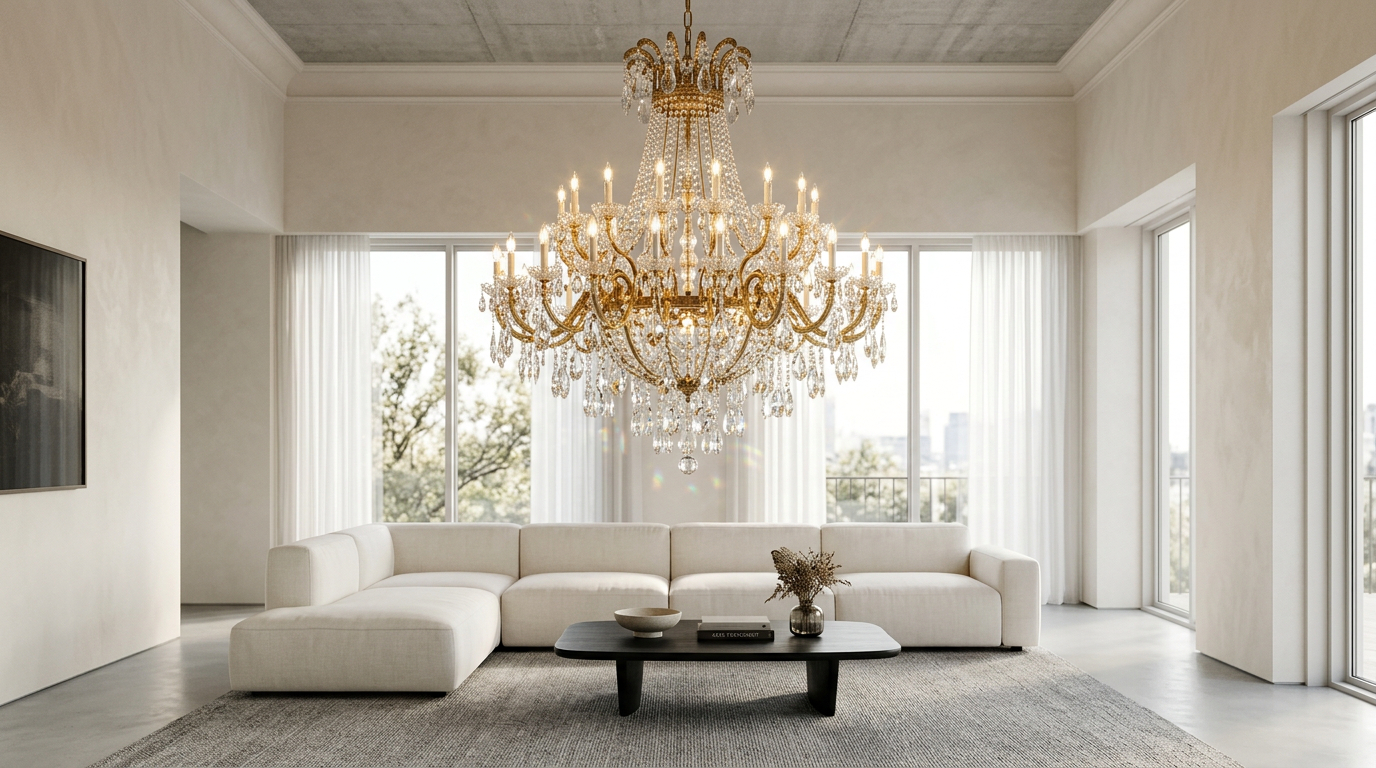
Where centuries-old grandeur meets the clean lines of today
Introduction: Why the Baroque Chandelier Refuses to Retire
There is a quiet rebellion happening in interior design. While minimalist spaces once demanded restraint, a growing movement is proving that Baroque chandeliers—those cascading, crystal-laden masterpieces born in 17th-century Europe—have found an unexpected second home in modern interiors.
The magic lies in contrast. A single Baroque chandelier suspended above a stark concrete table doesn’t clash; it converses. It bridges the gap between old-world opulence and contemporary restraint, creating spaces that feel curated rather than decorated.
This guide explores how to thoughtfully incorporate Baroque chandeliers in modern interiors, offering practical strategies for blending historical drama with today’s aesthetic sensibilities.
Understanding the Baroque Chandelier: A Quick Primer
Before placing one in your space, it helps to understand what defines the style:
| Characteristic | Description |
| Materials | Cut crystal, gilded bronze, wrought iron, hand-blown glass |
| Structure | Tiered arms, cascading pendants, symmetrical arrangements |
| Motifs | Scrollwork, acanthus leaves, floral details, cherubs |
| Lighting Effect | Refractive, warm, atmospheric—designed to dazzle |
Originally created to illuminate palaces and churches, these fixtures were engineered to impress. Today, that same dramatic DNA can energize even the most understated modern room.
The Design Philosophy: Contrast as a Tool, Not a Clash
The core principle for integrating Baroque chandeliers into contemporary spaces is intentional juxtaposition. Here is how designers make it work:
1. Minimalist Spaces + Maximum Chandelier
The Concept: Let the chandelier be the sole statement piece.
In a room defined by white walls, low-profile furniture, and negative space, a Barandelier becomes sculpture. The eye has nowhere else to go, and the fixture reads as art rather than ornament.
Design Tips:
- Choose a space with high ceilings to accommodate scale without visual compression
- Keep furniture silhouettes low and linear (think platform sofas, Noguchi tables)
- Use a monochromatic palette (whites, greys, warm taupes) so the chandelier’s complexity has room to breathe
Real-World Example: A Brooklyn loft with exposed brick and polished concrete floors. The industrial shell provides the perfect neutral stage for a 24-arm crystal chandelier. The result? A space that feels gallery-like—edited, but never cold.
2. Industrial Interiors + Gilded Warmth
The Concept: Soften raw materials with reflective luxury.
Industrial design leans heavily on utilitarian materials: steel, reclaimed wood, Edison bulbs, visible ductwork. While visually compelling, these spaces can feel austere. A Baroque chandelier introduces warmth, texture, and human craftsmanship into the equation.
Design Tips:
- Hang the chandelier above a communal area—dining tables or kitchen islands work best
- Pair with matte-black or oil-rubbed bronze hardware to create a tonal bridge between old and new
- Consider a chandelier with aged or darkened metal finishes rather than bright gold for a more seamless integration
Real-World Example: A converted warehouse in London’s Shoreditch district. The owners installed a mid-sized crystal chandelier with dark iron arms above a 12-foot reclaimed wood dining table. The crystal catches the natural light from factory windows, while the dark metal echoes the room’s steel beams.
3. Scandinavian Simplicity + Ornate Drama
The Concept: Challenge “hygge” with a single baroque gesture.
Scandinavian design prioritizes function, light woods, and muted tones. Adding a Baroque chandelier here is the design equivalent of a plot twist—it disrupts expectations in the best way.
Design Tips:
- Select a chandelier with clear crystal and minimal colored glass to maintain the Nordic emphasis on light
- Keep the surrounding décor rigorously simple: no competing patterns or heavy drapery
- Use natural textiles (linen, wool, raw cotton) to ground the chandelier’s formality
Real-World Example: A Copenhagen apartment with pale oak floors and white plaster walls. A modest 8-arm crystal chandelier hangs in the living room, its prisms casting rainbow patterns across the walls in afternoon sun. The effect is ethereal rather than heavy.
Practical Considerations: Making It Work
Scale and Proportion
A common mistake is choosing a chandelier that overwhelms the space. Use this rule of thumb:
Room width (in feet) + Room length (in feet) = Chandelier diameter (in inches)
For example, a 12′ × 14′ dining room calls for a chandelier roughly 26 inches in diameter.
Ceiling Height
- 8–9 feet: Choose flush or semi-flush mounts, or a small chandelier with upward-facing arms
- 10–12 feet: Standard chandeliers work beautifully
- 12+ feet: Go grand. Double-tiered or cascading designs fill vertical space without feeling lost
Modern Wiring and LED Integration
Many antique Baroque chandeliers can be retrofitted with LED candle bulbs, reducing heat output and energy consumption while preserving the warm glow. Dimmer switches are essential—they let you shift from functional lighting to atmospheric ambiance.
Styling Strategies: The Details That Matter
The “One Grand Gesture” Rule
In modern interiors, restraint is key. If you install a Baroque chandelier, let it be the only ornate element in the room. Avoid:
- Ornate mirrors directly competing with the chandelier
- Heavy, patterned upholstery
- Additional crystal accessories
Think of the chandelier as the period at the end of a clean, modern sentence.
Color Palette Pairings
| Chandelier Finish | Best Modern Pairings |
| Clear crystal + gold | Warm whites, sand, camel, soft black |
| Clear crystal + silver/chrome | Cool greys, navy, crisp white, slate |
| Smoked crystal + dark metal | Charcoal, espresso, olive, terracotta |
| Colored crystal (amber, amethyst) | Neutral backgrounds only—let the color sing |
Unexpected Placements
Designers are increasingly placing Baroque chandeliers in non-traditional locations:
- Bathrooms: Above a freestanding tub in an all-white marble space
- Walk-in closets: Transforming dressing areas into boutique-like experiences
- Home offices: Adding gravitas above a clean-lined desk
- Outdoor covered patios: Protected under a pergola for alfresco drama
Sourcing: Authentic vs. Inspired
| Option | Pros | Cons |
| Antique (17th–19th century) | Authentic patina, historical value, true craftsmanship | High cost, may require rewiring, fragile |
| Vintage Reproduction (mid-20th century) | More accessible price, often solid quality | Less investment value, may need restoration |
| Contemporary Baroque-Inspired | Reliable wiring, customizable sizes, warranty | Lacks historical soul, variable quality |
| Custom Commission | Perfect scale and finish for your space | Highest cost, longest lead time |
For modern interiors, contemporary reproductions often make the most practical sense—they offer the visual impact without the maintenance concerns of centuries-old wiring.
The Psychology Behind the Trend
Why does this pairing resonate so deeply?
- Narrative Depth: A Baroque chandelier carries stories. In a minimalist room, it introduces layers of history and human craftsmanship that flat-pack furniture cannot replicate.
- Emotional Warmth: Modern spaces can feel clinical. Crystal and candlelight introduce softness and intimacy.
- Individuality: In an era of mass-produced design, a statement chandelier signals curation and personal taste.
As designer Kelly Wearstler notes: “The most compelling interiors are those that don’t adhere to a single era. They collect moments.”
Conclusion: The Art of Balanced Contradiction
Integrating Baroque chandeliers in modern interiors is not about nostalgia. It is about creating tension—between ornate and minimal, historical and contemporary, warm and cool. When done thoughtfully, the result is a space that feels timeless rather than trendy, personal rather than prescriptive.
The key is confidence. Choose one exceptional piece. Give it space. Let it speak.
Your modern interior does not need to whisper. Sometimes, it deserves to sing.
Ready to find your perfect piece? Start by measuring your space, defining your palette, and remembering the golden rule: in the dialogue between old and new, let one voice lead.